
Walk into the storage aisle at any Home Depot, Walmart, or Target and you'll see at least a dozen different kinds of plastic bin. Snap-lid totes, latching totes, gasket-sealed boxes, wheeled under-bed drawers, collapsible fabric cubes, modular tool systems. A wall of categories that mostly look the same from a distance.
Each one is built for a slightly different job. Knowing which variety you're actually buying is the difference between a bin that lasts a decade and one you replace in three years, or between shelves that hold their shape and shelves that sag.
Here's a field guide to the main types, what they're designed for, and roughly what they cost, with extra attention to the two sizes most households end up owning: the 27-gallon industrial tote and the 66-quart latching box.
Key takeaways
- Plastic storage bins fall into roughly eight categories: snap-lid totes, latching totes, gasket-sealed bins, heavy-duty HDPE bins, under-bed drawers, collapsible fabric, file boxes, and modular tool systems
- The 27-gallon industrial tote is the default garage and basement workhorse, typically $10-15 at Walmart or Home Depot
- The 66-quart latching box is the default closet-shelf workhorse, typically $9-15 and sized to fit standard wire shelving
- Gasket-sealed bins (IRIS WeatherPro) cost 2-3× the equivalent non-sealed bin and earn that premium only where moisture or humidity is a real risk
- Polypropylene without UV stabilizers can lose 70% of its strength after 12 months of direct sun, so material and color matter for anything stored outdoors
What makes one storage bin different from another?
Before walking through the types, it helps to name the five attributes that separate them.
The first is material. Nearly all household bins are polypropylene (PP). Heavy-duty bins are often high-density polyethylene (HDPE) instead, which holds up better to cold and rough handling. Fabric and canvas bins are their own category, used mostly in living spaces.
The second is the lid. Snap-on lids press into place with friction. Latching lids clip with side buckles. Gasket-sealed lids add a rubber ring for water and dust resistance. Each tier adds cost and adds security.
Third, transparency. Clear bins let you see contents without opening them. Opaque bins don't. This matters more for how often you open the bin than for how the shelf looks.
Fourth, shape. Stackable bins have ridges on the lid that lock with the base of the bin above. Nesting bins taper inward so empty bins fit inside one another. Some bins do both.
Fifth, size and footprint. Capacity in gallons or quarts matters less than whether the bin fits the shelf or floor space you have. Two bins with the same volume can have wildly different dimensions, and a lot of bins get returned because they don't fit.
Almost every bin category below is a combination of those five attributes. Once you know what each attribute does, the shelves stop feeling like a wall of plastic.
The basic snap-lid tote
The snap-lid tote is the default storage bin in most households. It's the one most people picture when they hear "plastic bin." The lid presses on and holds with friction. No latch, no gasket, no seal. The construction is polypropylene, usually opaque, and the size range runs from about 18 gallons up to 50+ gallons.
Snap-lids are cheap and widely available. They'll stack one or two high with reasonable content weight. Beyond that they start to fail: the lid flexes under compression and the bin below ends up with a bowed top.
They work for single-layer shelf storage, floor storage, and anything you rarely touch. They're a bad choice for anything you plan to stack four high or move around a lot.
The 27-gallon industrial tote
This is the big rectangular bin everyone has seen a thousand times. Roughly 30 × 20 × 14 inches, opaque, usually black with a yellow or red lid. Sold as "industrial tote," "tough tote," "rugged tote," or just "27-gallon tote" depending on the brand. Capacity ratings between 26 and 30 gallons are all essentially the same box with minor molding changes.
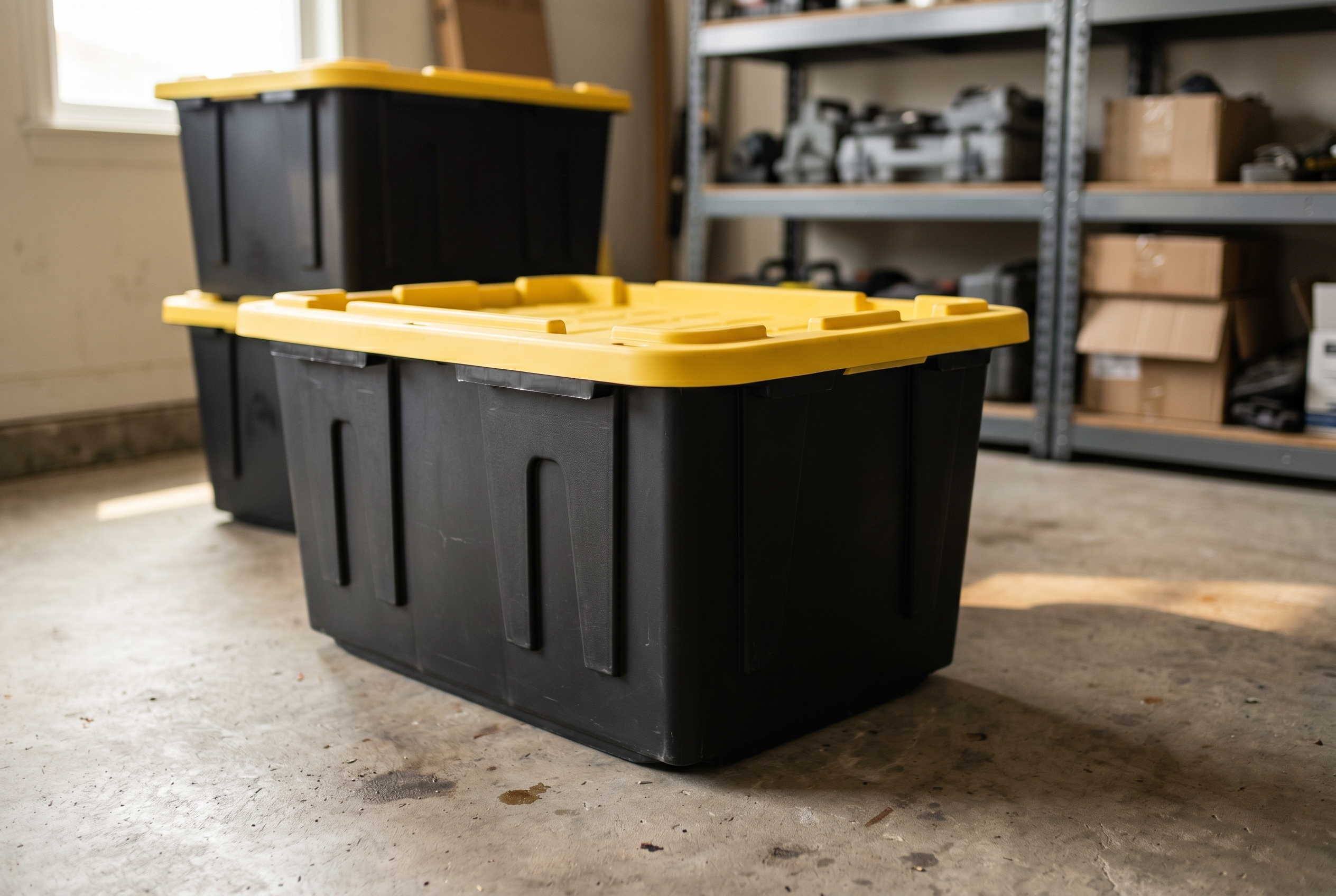
According to Wirecutter's most recent testing, Home Depot's HDX Tough Storage Tote is the cheapest serviceable 27-gallon you can buy: a dozen for about the price of one or two premium bins. That's the benchmark to beat, because 27-gallon storage is really a bulk-buy category for garage and basement use.
Twenty-seven gallons is the right size for heavy, bulky items you access rarely. Power tools. Holiday decorations. Automotive parts. Camping gear. Extra bedding. Things you load once and ignore for six months.
It's the wrong size for anything you reach into more than once a month. The bin is heavy enough empty (around 8 pounds) that lifting a full one at 60-70 pounds off a shoulder-height shelf isn't something you want to do often. The footprint is also too large for most closet shelves.
Common 27-gallon products and rough prices as of April 2026:
| Product | Typical price (single) | Lid style | Where |
|---|---|---|---|
| HDX Tough Storage Tote | $8-10 | Snap | Home Depot only |
| Sterilite 27-gal Industrial Tote (snap lid) | $10-12 | Snap | Amazon, Walmart, Target, Home Depot |
| Rubbermaid Roughneck (25 gal) | $13-16 / 4-pack | Snap | Amazon, Home Depot, Lowe's |
| Greenmade 27-gal Storage Bin | ~$12.50 / 8-pack | Snap | Costco only ($99.99/8-pack) |
Buying in packs almost always beats buying singles. A 4-pack of Sterilite 27-gallon industrial totes runs about $45 at Walmart, roughly $11.25 each versus $14+ for a single bin. If you need six or more, go straight to a bulk pack. One caveat: don't buy a pack bigger than you'll use just because the per-unit price is lower. Bins are bulky, and storing six empty ones defeats the point of having them.
The latching tote
The latching tote is a snap-lid with an upgrade. Instead of friction, the lid clips with two side buckles that lock against the base. That small change does a lot. The lid stays on when you pick the bin up by the handles, and stacks of three or four bins hold their shape without crushing the ones below.
Latching totes cost roughly $2-4 more per bin than the equivalent snap-lid. That's almost always worth it if the bin will be moved, stacked high, or loaded onto a moving truck. The Sterilite latching 27-gallon and the Sterilite 66-quart Clear Latch Box are the two best-selling products in this style.
The 66-quart latching box
The 66-quart Sterilite clear latch box is one of the highest-volume products in the plastic storage aisle. It goes on sale for around $9 at Walmart (it was $8.98 in February 2026 per a Slickdeals listing) and runs $12-15 at regular price. For context, 66 quarts equals 16.5 gallons, about 40% smaller than a 27-gallon tote.
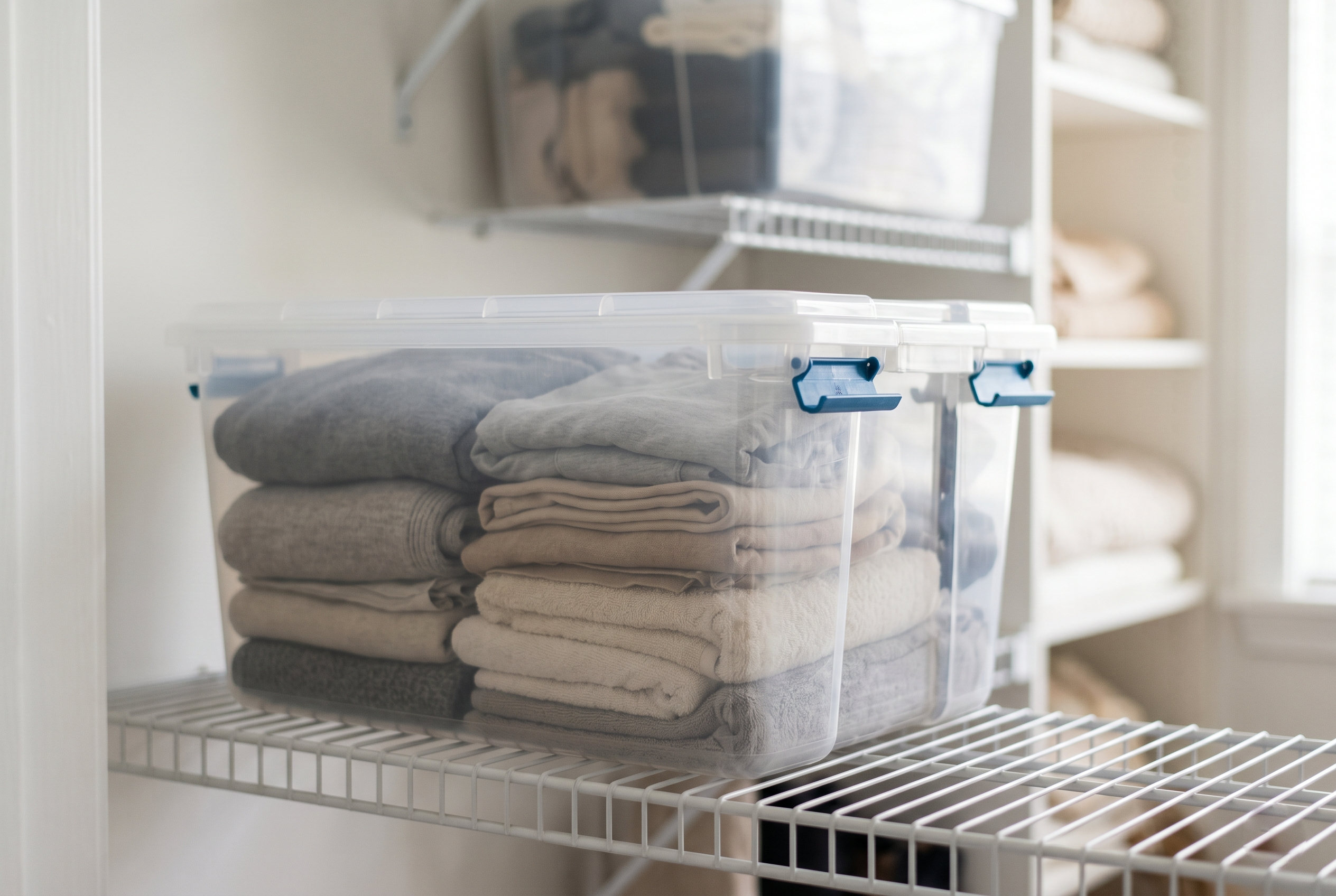
The dimensions are what make this size popular: roughly 24 × 16 × 13 inches. It fits on the 16-inch depth of standard wire closet shelving (ClosetMaid and similar) and under the 14-inch clearance of most upper closet shelves. You get a lot of storage per cubic foot without the bin overhanging the shelf or forcing you to build custom shelving.
Sixty-six quarts is the right size for clothing and linens (one bin holds a family member's worth of off-season clothes), toys, books, craft supplies, kids' keepsakes, and anything soft or mid-weight you pull out a few times a year.
It's the wrong size for really heavy items. 66-quart latch bins are almost always polypropylene (Sterilite's lineup is mostly clear with color-accented latches; Hefty's equivalents come in opaque colors), and polypropylene gets brittle in garages that drop below freezing. That's why Wirecutter's most durable pick is HDPE rather than polypropylene.
Common 66-quart products and rough prices:
| Product | Typical price (single) | Notes | Where |
|---|---|---|---|
| Sterilite 66-qt Latch Box | $9-13 | Standard latch box, color-accented latches | Amazon, Home Depot |
| Sterilite 66-qt ClearView Latch Box | $10-14 | Premium ClearView line, color-accented latches | Amazon, Walmart |
| Sterilite 66-qt Ultra Storage Box | $14-18 | With wheels for under-bed use | Amazon |
| Hefty 66-qt Storage Bin | $10-14 | Similar specs to Sterilite | Amazon |
| IRIS USA WeatherPro 60-qt (3-pack) | $60-90 / 3-pack | Gasket-sealed, bulk | Amazon |
A lot of households end up with two sizes total: 27-gallon totes for the garage and 66-quart latch bins for everywhere else. It's not a bad starting system.
Clear bins
Clear bins are polypropylene molded without pigment. You can see contents through the sides and lid without lifting anything. Sterilite ClearView, IRIS WeatherPro, and most "shoebox"-style bins are clear.
The advantage is obvious: you skip the labeling problem. A bin marked "kids' art supplies" covers dozens of items you dig through often, and being able to spot a specific marker from across the room saves minutes every time.
The tradeoffs are less obvious. Clear polypropylene bins tend to crack and yellow faster than opaque ones, partly because the pigments in opaque bins (black especially) contain carbon black, which absorbs UV and protects the plastic. Clear bins also broadcast their contents, which is great in a pantry and a mess on a living room shelf.
Use clear bins for anything you open often in a place where sun and temperature are controlled. Skip them for living rooms, outdoor storage, and hot garages.
Opaque bins
Opaque bins are pigmented polypropylene, usually black, grey, or primary colors. The 27-gallon industrial tote is the most familiar example, but opaque bins exist at every size.
Opaque bins last longer in harsh conditions. The pigment blocks UV, and the walls are often slightly thicker than clear equivalents. They also hide the visual noise of 12 differently shaped items, which is why most professional organizers reach for opaque on anything that sits out in a living space.
The tradeoff is you have to label them. Handwritten labels go stale the second you reorganize. Sticker labels peel. Any opaque bin system needs a labeling strategy: masking tape, preprinted labels, or QR codes linked to a digital inventory.
Stackable bins
Stackable means the filled bin sits securely on top of another filled bin without crushing it. The mechanism is usually ridges or recesses on the lid that lock into the base of the bin above. Latching lids stack more securely than snap lids because the lid doesn't flex under load.
Stackable bins matter most in garages with limited shelving and in closets where you're going two or three bins high. For a single layer on a shelf, the feature is irrelevant.
One lesson from setups customers send us: the bins that fail in garages almost never fail because of what's inside them. They fail because someone stacked them in a column that drifted half an inch out of plumb over a year, and the lid of the bottom tote warped from the weight. Stack against a wall when you can, or use shelving with one bin per shelf.
Nesting bins
Nesting bins taper slightly toward the base so an empty bin fits inside another empty bin. The point is to save space when the bins aren't in use, which matters a lot in seasonal storage where half your bins sit idle six months a year.
IRIS WeatherPro bins, for example, stack when full and nest when empty. That combination is why Wirecutter rates them its everyday pick: stacking security when loaded, compact storage when not.
Nesting without stacking is rare in heavy-duty bins. It shows up more in mid-size closet bins and stackable shoeboxes.
Weathertight, gasket-sealed bins
Sealed bins use a rubber or silicone gasket around the lid plus positive-latching clips to make a near-airtight seal. IRIS WeatherPro is the best-known line, with sizes from 6.5 quart up to 156 quart. These bins cost roughly 2-3× the equivalent-capacity non-sealed bin.
Whether the upcharge is worth it comes down to three questions:
- Is the bin stored somewhere humid or flood-prone? Basements, crawlspaces, and sheds are where gasket sealing pays for itself the first time a pipe leaks.
- Are the contents high-value or perishable? Documents, photos, fabrics, electronics, emergency supplies with expiration dates. The seal keeps moisture and pests out.
- Is the bin going outside? Sheds, uncovered porches, and cargo trailers let rain and humidity in through the lid seam of non-sealed bins.
If any of those apply, the upcharge earns its keep. If not, you're paying extra for protection you don't need.
Heavy-duty HDPE bins
The other premium category is bins made from high-density polyethylene (HDPE) rather than polypropylene. Rubbermaid Brute totes and the Rubbermaid ActionPacker are the classic examples. HDPE handles cold better than polypropylene, which goes brittle in freezing garages, and it takes rougher handling without cracking.
HDPE bins cost $30-80 per unit depending on size. Buy them if the bin is going to get kicked around in a truck bed, sit in an unheated garage through winter, or hold anything industrial: food-service containers, contractor gear, emergency supplies.
UV exposure is the underrated factor here. Non-stabilized polypropylene can lose up to 70% of its strength after 12 months of direct sun, while UV-stabilized polypropylene can last up to 5 years outdoors, and HDPE lasts longer still. Any bin you plan to keep on a covered porch, in a shed with windows, or in a sunlit garage should be UV-stabilized (usually labeled as such), dark-colored, or HDPE. Clear bins outdoors are a mistake.
Under-bed and wheeled bins
Under-bed bins are shallow (about 6 inches tall), wide, and usually fitted with four swivel wheels on the base. Sterilite's 66-quart Ultra Wheeled Underbed Box is the go-to at around $14-18.
The wheels are the feature that matters. You'll be pulling these out from under the bed constantly. Without wheels, the bin scrapes the floor and gets stuck on rugs. Clear polypropylene with a latching lid is the standard construction.
Typical contents: shoes, off-season clothing, linens, gift wrap, under-bed toy storage. The shallow height also makes them useful on deep closet shelves where a full-height bin would waste the space above it.
Collapsible and fabric bins
Fabric, canvas, or polyester bins that fold flat when empty. IKEA's SKUBB is the reference product. Prices run $5-15 per bin.
Fabric bins work on closet shelves where the contents change seasonally and the shelf is visible. They're a bad choice in garages and basements. They absorb moisture, mildew, and tear under weight. Nothing structural belongs in them.
A related category is decorative bins made from seagrass, rattan, or fabric-wrapped cardboard for living spaces. These run $15-50, look good on a shelf, and work for pillows, throws, or anything lightweight. They're not meant for heavy items or frequent moves.
File boxes and document bins
Rectangular bins sized for hanging file folders, usually with lid-integrated rails the folders hang from. IRIS Letter/Legal File Box and Sterilite 18-quart File Box are the common options at $12-25.
Most households still own one or two even in the paperless era. Tax returns, warranties, medical records, kids' school papers you don't want to scan. File boxes also stack well because they're narrow and have flat lids, so a column of three against a closet wall is a reasonable archive setup.
Modular tool-system bins
DeWalt ToughSystem, Milwaukee Packout, Bosch L-Boxx, and Festool Systainer. These are their own ecosystem: modular cases that interlock, stack, and roll as a single unit. They're built for the trades and have spilled into DIY and hobbyist use.Individual cases run $40-150. A full kit with a rolling base and three or four stacked cases runs $300+. Worth it if you move tools between job sites or want integrated storage inside a specific brand's ecosystem. For general household storage, regular bins cost a fraction as much.
Price per gallon across bin types
If you strip away the features and ask which bin gives you the most storage per dollar, the answer is consistent: large opaque bins, bought in packs, with snap lids. Clear, latching, and gasket-sealed bins all cost more per gallon, sometimes much more.
A Sterilite 27-gallon snap-lid tote at $11.50 works out to about 43 cents per gallon. An IRIS WeatherPro at $40 for 40 quarts (10 gallons) is about $4.00 per gallon, roughly nine times the cost. You pay that premium for the gasket seal, UV-stabilized plastic, stacking ridges, and a brand with a durability track record. Whether it's worth it depends on what's inside.
One practical rule: put your cheapest bins on the heaviest, least-sensitive contents and your most expensive bins on the rarest, hardest-to-replace ones. Most people do the opposite. Expensive bins go in the garage where they get bashed around, cheap bins go in the closet where they would have been fine.
A short picking guide
Walk through four questions before buying:
- Where is the bin going to live? Garage or basement → opaque, heavy-duty, polypropylene or HDPE. Closet or indoor shelf → clear or opaque, whichever you prefer to see. Outdoors or damp → sealed and UV-stabilized.
- How often will you open it? Daily or weekly → clear, small-to-medium size. Monthly → clear or opaque. Quarterly or less → opaque is fine.
- How heavy are the contents? Under 20 pounds → any size works. 20-40 pounds → latching lid. Over 40 pounds → 27-gallon tough tote or HDPE.
- How much vertical stacking? Two bins high → snap lid is OK. Three or more → latch required, and check that the lids have a base-locking ridge.
Those four questions usually land you on one of three answers: a pack of 27-gallon industrial totes, a pack of 66-quart latch bins, or an IRIS WeatherPro for a specific sealed-storage problem. That covers 90% of household decisions.
The bin is only half the system
Whichever variety you pick, you'll still forget what's inside.
That's the part plastic can't solve. Two 27-gallon opaque totes look identical. Even a clear bin is hard to read from across the garage. Handwritten labels go stale the second you reorganize. The average American spends about 2.5 days a year looking for lost items, not because the items aren't in a bin but because nobody remembers which bin.
The cheap fix is a QR sticker on each bin linked to a digital inventory. Scan the sticker with your phone, see what's inside, add or remove items in a tap. Stickers cost pennies. The app is free if you self-host.
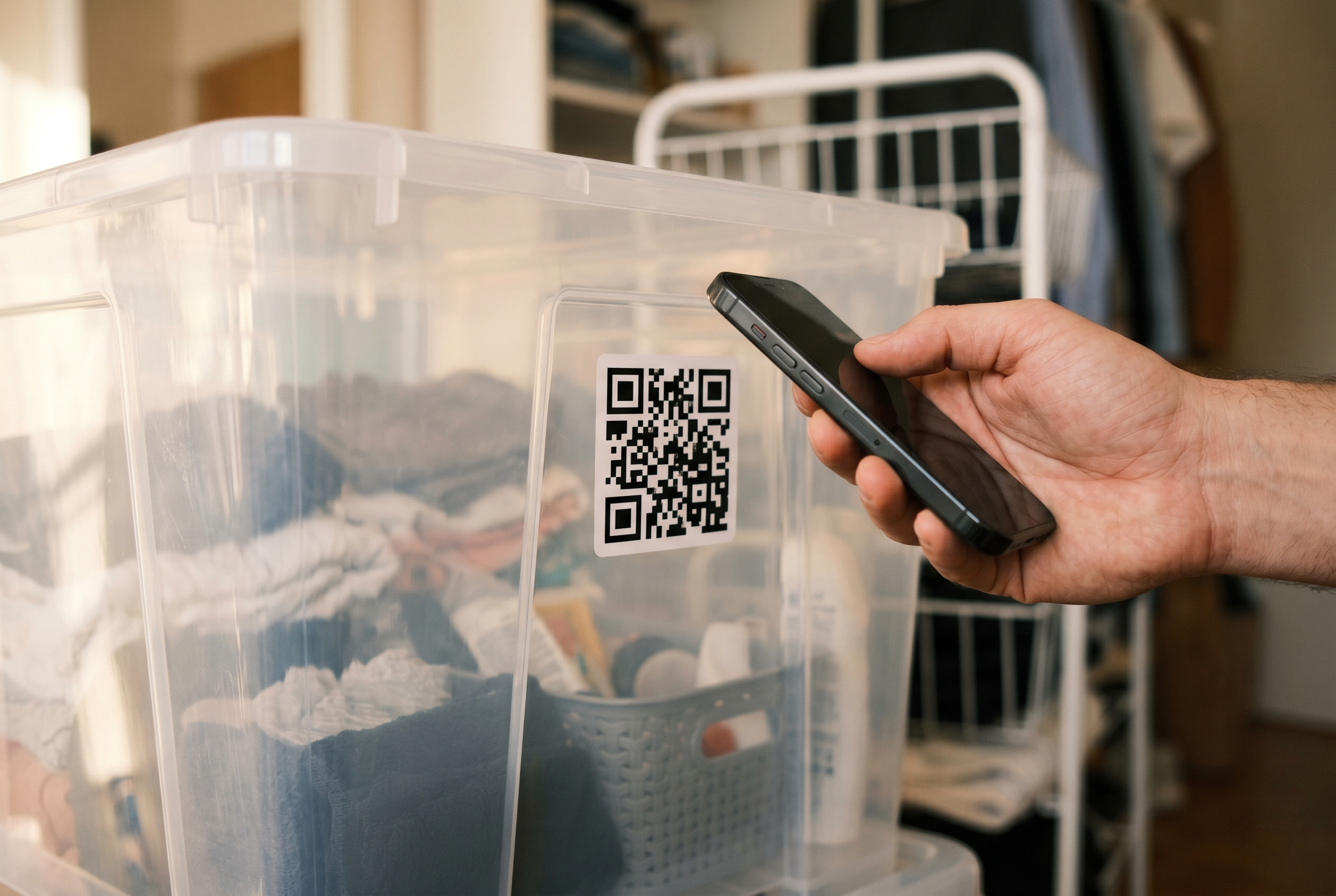
For the full walkthrough — what QR labels to buy, how to photograph contents so an app can auto-catalog them, how to handle multi-user updates when the bin gets reshuffled — see how to keep track of what's in every storage bin. OpenBin is free to self-host and the setup takes about 30 minutes. The cloud version has a free tier if you'd rather not run a server.
The bins are the easy part. The tracking is what makes them findable.
Frequently asked questions
How many types of storage bins are there?
There are roughly eight main categories of plastic storage bin: snap-lid totes, latching totes, gasket-sealed weathertight bins, heavy-duty HDPE bins, under-bed wheeled drawers, collapsible fabric bins, file boxes, and modular tool-system bins. Each is built for a specific combination of weight, access frequency, and environment.
Is a 27-gallon bin the biggest standard size?
It's the largest common household tote, but larger sizes exist. IRIS WeatherPro goes up to 156 quarts (about 39 gallons) in sealed form, and industrial bins from Rubbermaid go up to 45 gallons and beyond. For household use, 27 gallons is usually the practical maximum. Anything bigger is hard to lift when full.
Why do storage bins crack or yellow over time?
Polypropylene, the plastic used in most clear storage bins, degrades under UV light and temperature cycling. Without UV stabilizers it can lose up to 70% of its strength after 12 months of direct sun. Keep clear bins out of direct sunlight, or buy UV-stabilized, opaque, or HDPE bins for areas with sun exposure.
Are latching lids worth the extra cost?
For stacking three or more high, yes. Snap lids flex under weight and can pop off. For single-layer storage or two-high stacks, snap lids save a few dollars per bin and work fine. The $2-4 premium for a latching 27-gallon tote is worth it if the bin is going into a stack or being moved around.
What's the difference between stackable and nesting bins?
Stackable means filled bins sit securely on top of each other via ridges on the lid. Nesting means empty bins taper inward so they fit inside one another, saving space when not in use. Some bins (like IRIS WeatherPro) do both. Cheap totes often do neither well.
Can I store a storage bin outside?
Only if it's UV-stabilized and gasket-sealed, and preferably dark-colored. Non-sealed bins let moisture in through the lid seam. Non-UV-stabilized polypropylene can lose most of its strength within a year of full sun exposure, while UV-stabilized polypropylene can last up to 5 years outdoors. For long-term outdoor storage, an IRIS WeatherPro, a Rubbermaid ActionPacker, or a dedicated outdoor deck box is a better investment than a standard tote.
The short version
Most households end up with two base sizes: a pack of 27-gallon opaque industrial totes for the garage and a pack of 66-quart latching clear bins for indoor shelves. Add IRIS WeatherPros only where sealing earns its keep: basements, outdoor storage, or high-value fabrics. Add HDPE bins like the Rubbermaid Brute only where the bin will see rough handling or cold winters. Then put a QR label on every bin, because the best storage bin in the world is still just a plastic box until you can search what's inside.