
Every January the routine is the same. Take down the tree, wrap the ornaments, coil the lights, stack everything into bins, and shove them into the attic. By next December, you're standing up there holding your phone flashlight, opening every lid because you can't remember which red tote has the tree lights and which one has the wrapping paper.
According to a Rainbow Restores survey, 35% of Americans buy new decorations every year. Some of that is by choice. But plenty of it is because people replace things they already own and can't find.
This post covers a system for holiday decoration storage that survives 12 months in the attic. It takes about 30 minutes to set up and costs nothing.
Key takeaways
- Stick QR code labels on holiday bins and scan them to see contents, photos, and notes
- AI photo recognition catalogs ornaments and lights without manual typing
- The system works for all seasonal holidays, not just Christmas
- 30 minutes of setup saves you from buying duplicates every December
Why are holiday decorations hard to track year to year?
Holiday decorations are uniquely hard to keep track of. You use them for four weeks, then store them for eleven months. That's the longest gap between "organized this" and "need to find this" of anything in your house.
Nearly 9 in 10 Americans decorate for Christmas. The average household spends $148 per year on holiday decor — part of a $5.33 billion global market in 2024, projected to reach $7.32 billion by 2030. All of that goes into bins once a year.
And the labeling problem is worse here than anywhere else. You label a bin "Christmas — ornaments" in January. By December, you've forgotten whether the vintage glass ornaments are in that bin or the other one that says "Christmas — tree stuff." Maybe you moved the outdoor lights into a different tote in March when you needed space for camping gear. The label didn't change.
Handwritten labels would be fine if the gap between packing and unpacking was a week. At eleven months, they're basically decorative.
What does a QR label do for seasonal storage?
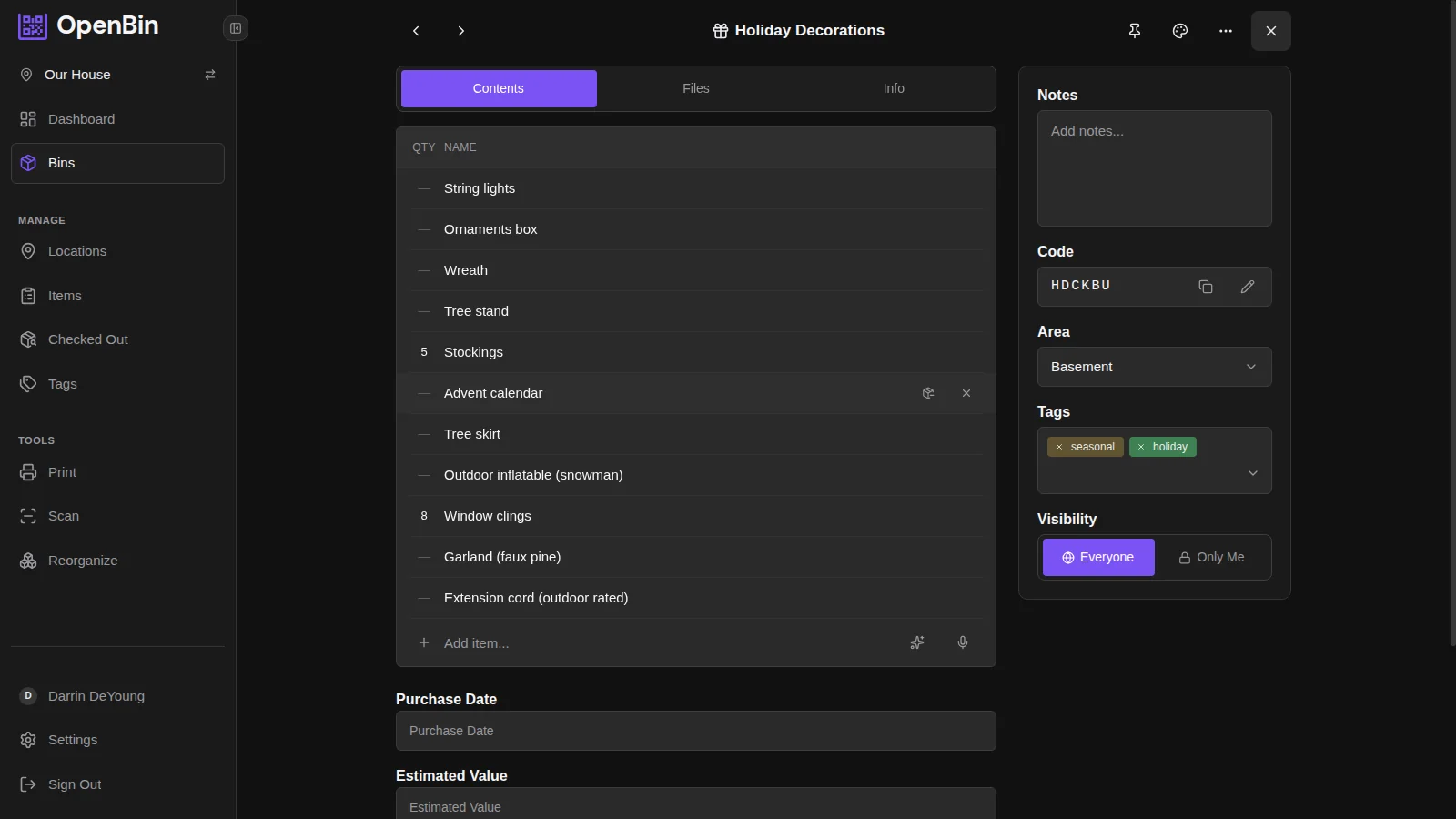
A handwritten label says "Christmas — misc." A QR scan shows you exactly what's in the bin: string lights (3 sets, one warm white, two multicolor), ornament box with the red and gold collection, tree skirt, spare hooks, and the angel topper. Plus photos of the contents taken the day you packed it.
The label survives the whole year. Nothing fades, nothing falls off. And if you reorganize bins during the off-season, you update the inventory from your phone. The QR sticker on the bin stays the same. The contents list changes.
This is the part that makes QR labels worth the effort over handwritten ones. For things you access weekly, a Sharpie label works fine. For things you access once a year, you need something that carries more information than three words on a piece of tape.
For a deeper walkthrough of how QR bin tracking works, see how to keep track of what's in every storage bin.
How do you set up holiday bins with OpenBin?
OpenBin is a free, open-source inventory app I built for exactly this kind of problem. Here's how to set up holiday storage.
Create a location and a holiday area. Your location is your house. Create an area called "Holiday Storage" (or "Attic — Holiday" if you want to be specific about where the bins live). If you store holiday items in multiple places, create an area for each.
Create one bin per category. Don't pack everything into one giant tote. Break it up by type:
- Tree (artificial tree sections, stand, skirt)
- Ornaments (wrapped individually or in divider trays)
- Lights (indoor string lights, outdoor lights, extension cords)
- Outdoor decor (inflatables, yard stakes, wreath)
- Wrapping and gift supplies (paper, ribbon, bags, tags)
- Miscellaneous (stockings, table runners, candles)
Each bin in the app maps to a physical container. Six bins, six entries. For what kind of plastic bin to buy (snap-lid vs. latching vs. gasket-sealed), see the storage bin field guide.
Photograph everything before you close the lid. This is where the AI helps. Open a bin, snap a photo, and OpenBin's photo recognition lists what it sees. It'll identify "string lights," "ornament storage box," "extension cord" without you typing a word. Review the list, adjust anything it missed, and save.
Print QR labels and stick them on the lids. Generate a label sheet from the print labels screen. Peel, stick, done. One sticker per bin. Standard label paper works. About three cents per sticker if you're using Avery sheets.
Add notes for next year. This is something no handwritten label can do. Add a note to a bin: "Replace the warm white strand — burned out halfway through." Or "The angel topper's wing is loose, wrap it separately." Future-you will appreciate it.
Think beyond Christmas
The same system handles every seasonal holiday. Halloween goes in its own bins. Easter, Fourth of July, Thanksgiving — whatever you decorate for. One "Holiday Storage" area in the app, with bins labeled by season and category.
This matters because holiday bins overlap in physical storage space. The Halloween bin gets stacked on top of the Christmas bins in January. In October, you need to reach it without disturbing everything underneath. If you know which bin is which from a phone search — "where's the Halloween tablecloth?" → "Holiday Storage, Bin 3, top of the stack" — you're not moving six totes to find it.
You can tag bins by holiday (Christmas, Halloween, Easter) and filter by tag. Search "Christmas lights" and get every bin that has lights in it, regardless of which area it's stored in.
If some of your holiday storage is craft-related — handmade ornaments, ribbon for wreaths, seasonal fabric — the same inventory works for both. See how to organize craft supplies when you have way too many for a craft-focused setup.
The cost of forgetting
Quick math. If you buy two duplicate items per year because you forgot you already owned them — a $15 string of lights here, a $12 pack of ornament hooks there — that's $27 per year. Over ten years, $270. The national average spend on holiday decor is $148/year, so duplicates could account for a meaningful chunk of that.
An inventory that takes 30 minutes to set up pays for itself the first December you don't buy replacement lights.
How do you share a holiday inventory with your household?
Who decorates at your house? If it's more than one person, they need access. Otherwise you're back to texting "which bin has the outdoor extension cords?"
OpenBin supports multiple users per location with invite codes. Your partner, your kids, your parents who visit and help decorate — anyone with access can scan a bin or search the inventory from their own phone. Three permission levels: admin, member, and viewer.
Frequently asked questions
What if I reorganize bins between years?
Update the bin contents in the app when you move things around. The QR sticker stays on the physical bin. The inventory reflects whatever's currently inside. That's the whole point — the system stays in sync with reality.
Can I add notes about broken or missing items?
Yes. Add text notes to any bin. "Broken bulbs in strand 2" or "need new tree stand next year." When you unpack in December, the notes are right there.
What about outdoor decorations stored in a shed or garage?
Create a separate area for each storage location. "Garage — Holiday" and "Attic — Holiday" can both exist under the same location. Search works across all areas, so it doesn't matter where you stored something.
Is OpenBin free?
Yes. Free cloud tier or self-host with Docker. The code is open source (AGPL-3.0) on GitHub.
Next December is eight months away
That's eight months for labels to fade, bins to get shuffled, and memories to blur. Spend 30 minutes now — while you still remember what went where — and next year's setup will take half the time.